
Inputs Are Leadership Decisions: Why the Conditions We Design Shape the Learning We See
OO
Opening Thought
Instructional leadership is filled with constant decisions. What to introduce. What to prioritize. What to require. What to let go. Most of these decisions are made with good intentions and under real pressure. Yet over time, they quietly shape the experience of teaching and learning in our schools.
As instructional leaders, every structure, expectation, and message we introduce becomes an input into the system we lead. And those inputs whether intentional or not determine the outputs we eventually measure.
Before focusing on outcomes, it's worth pausing to examine the conditions we are designing. Because schools do not improve through effort alone. They improve through design.
A Simple Leadership Truth
In health, we understand this instinctively. What we put into our bodies determines how we feel, how much energy we have, and how well we function. Fast food produces predictable results. Nourishment produces different ones.
Leadership environments operate the same way. The dominant inputs we design will always shape the outputs we observe.
This is not a moral statement. It's a systems reality.
What Are the Inputs We're Designing for Teachers?
In many schools, the daily leadership inputs look like this:
- Multiple initiatives layered simultaneously
- Pacing guides with limited room for professional judgment
- Checklists intended to drive consistency
- Frequent walkthroughs focused on compliance indicators
- A persistent sense of urgency without reflection None of these inputs are inherently harmful. Most are well-intentioned. But when they become the primary experience of teaching, the outputs are predictable:
- Surface-level engagement
- Minimal instructional risk-taking
- Teacher fatigue masked as compliance
- Improvement that looks active but feels shallow
The system produces exactly what it is designed to produce.
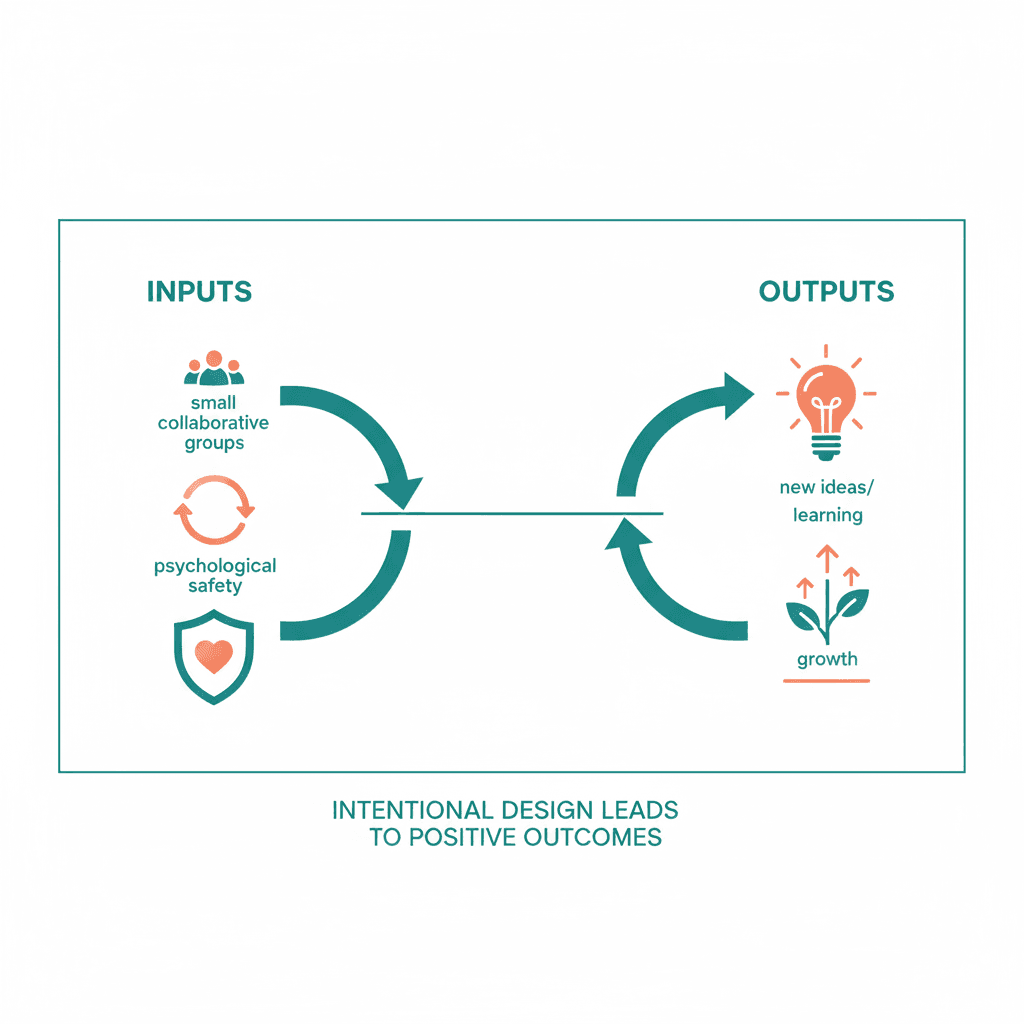
The alternative isn't to remove structure it's to redesign it. When instructional improvement happens through collaborative teams focused on shared practice challenges, the inputs shift fundamentally. Teachers experience autonomy within structure, psychological safety within accountability, and rhythm within urgency.
Instructional Improvement Is a Design Problem
When leaders encounter disengagement or uneven instructional practice, the instinct is often to add more:
More monitoring
More structures
More expectations
But improvement rarely accelerates through accumulation. It accelerates through design clarity.
The more powerful question is not: Why aren't teachers doing more?
It is: What conditions are we creating that shape how teachers think, plan, and act?
This is where instructional leadership shifts from managing behavior to designing environments for learning.
The answer isn't more initiatives. It's rhythmic cycles where small teams identify specific instructional challenges, test research-based practices together, and refine their teaching through repeated implementation. This isn't another layer it's a different operating system entirely.
The Invisible Inputs We Often Overlook
Beyond systems and structures, there are psychological inputs that shape teaching just as strongly:
- Do teachers experience psychological safety when trying something new?
- Is reflection framed as learning or evaluation?
- Are challenges treated as shared puzzles or individual shortcomings?
- Is time positioned as a resource or a constant constraint?
These inputs influence whether teachers bring curiosity or caution into their classrooms. And curiosity not compliance is what drives meaningful instructional improvement.¹
These psychological inputs don't happen by accident. They're built into how teams work together through facilitated inquiry, collective problem-solving, and shared ownership of instructional challenges. Research on collective teacher efficacy confirms this: when teachers work in teams focused on shared instructional problems, student outcomes improve significantly.²
Leaders Are Shaped by Inputs Too
There is a leadership reality we rarely name: Principals and instructional leaders are also shaped by their inputs.
Many leaders operate in environments defined by:
- Constant urgency
- Competing expectations
- Isolation in decision-making
- Pressure to project confidence even amid uncertainty
When leaders lack reflective and grounding inputs, those conditions quietly transfer throughout the system. This is why leadership sustainability is not only a strategic concern—it is a human one.
Some leaders cultivate those inputs through trusted peers, reflective practice, or intentional pauses. Others seek creative spaces such as Fearless Educator Radio as a way to reset, regulate, and reconnect with the human side of leadership.
Just as teachers need healthy instructional inputs, leaders need inputs that support clarity, perspective, and presence.
Why Leaders Don't Need to Be Content Experts
One of the most persistent myths in instructional leadership is that leaders must possess deep content expertise to guide improvement.
In practice, effective leaders do something more impactful:
- They design inquiry
- They surface instructional challenges through observation and questions
- They facilitate small teams through short cycles of learning
- They create space for teachers to analyze, test, reflect, and refine practice
Leadership, in this sense, is not about having the right answers. It is about creating the conditions where answers can emerge. This is the foundation of a Question-Driven approach to instructional leadership and it's precisely what structured professional learning communities are designed to enable.
When teams work through deliberate practice cycles focused on high-leverage teaching methods, the principal's role shifts from content expert to process architect. The expertise builds collectively, not individually.
Reimagining the Outputs
When leaders design structured PLCs focused on deliberate practice where teams identify challenges, test solutions in short cycles, and build shared expertise the outputs shift:
- Teachers take instructional risks because the team creates psychological safety
- Collaboration becomes purposeful, focused on specific practices rather than generic planning
- Improvement happens in visible weeks, not vague years
- Engagement increases for adults and students alike
Not because more was added. Because the rhythm of learning was redesigned.
This is what systematic improvement looks like: not a one-time training, but a continuous cycle of inquiry, implementation, and refinement. The rhythm itself becomes the container for growth.
Closing Thought
Schools do not improve through checklists alone. They improve when leaders intentionally design the conditions structural, psychological, and humantha t shape how people think, feel, and learn each day.
As instructional leaders, the choices we make what we introduce, emphasize, or require become the inputs that define our systems. Over time, those inputs quietly shape the outputs we observe in classrooms, collaboration, and culture.
When leadership decisions feel urgent or complex, return to this grounding pause:
Before introducing a new input, ask: What output will this create for the people experiencing it?
This question reframes leadership from reaction to design. It reminds us that improvement is not driven by accumulation, but by intention and that sustainable change begins with thoughtful inputs, not increased pressure.
Instructional leadership is not about control. It is about design. And design always determines results.
This is the work of instructional leadership and it requires infrastructure that honors how adults actually learn and grow.
Over the coming weeks in Lead Spark Journal, we'll explore what these intentionally designed systems look like in practice from launching effective PLCs to selecting high-leverage teaching practices to creating rhythmic improvement cycles that honor both urgency and sustainability.
Lead Spark Journal is published by Kampus Insights, a software publisher focused on instructional leadership infrastructure. Learn more at kampusinsights.com
References & Further Reading
¹ Edmondson, A. C. (2018). The Fearless Organization: Creating Psychological Safety in the Workplace for Learning, Innovation, and Growth. Wiley. [Research demonstrating how psychological safety enables learning and risk-taking in professional teams]
² Eells, R. J. (2011). Meta-Analysis of the Relationship Between Collective Teacher Efficacy and Student Achievement. Dissertations, 133. [Comprehensive analysis showing collective efficacy as one of the most powerful influences on student achievement]
For readers interested in adult learning design: Knowles, M. S., Holton III, E. F., & Swanson, R. A. (2015). The Adult Learner: The Definitive Classic in Adult Education and Human Resource Development (8th ed.). Routledge. [Foundational text on principles of adult learning and professional development]